Stephanie R.C. Validates Self-Regulated Learning Instruments for Elementary Students in Line with SDGs
Stephanie Rosalina Cangkat, a graduate student from the 2024 cohort of the Master’s Program in English Language Education, Universitas Negeri Surabaya, on October 2, 2025, held a seminar to validate her designed and developed research instrument for her thesis on Self-Regulated Learning (SRL) based on Zimmerman's theoretical framework. Her research focuses specifically on the context of elementary school students, a group that currently lacks appropriate and reliable SRL instruments tailored to their developmental stage.
The seminar was held as part of her thesis development process, with Dr. Muhaimin Abdullah, S.Pd., M.Pd., serving as the discussant/examiner, and Prof. Slamet Setiawan, M.A., Ph.D. and Syafi'ul Anam, Ph.D. acting as academic supervisors. The session was also attended by Ahmad Munir, Ph.D., the Head of the Master’s Program in English Language Education.
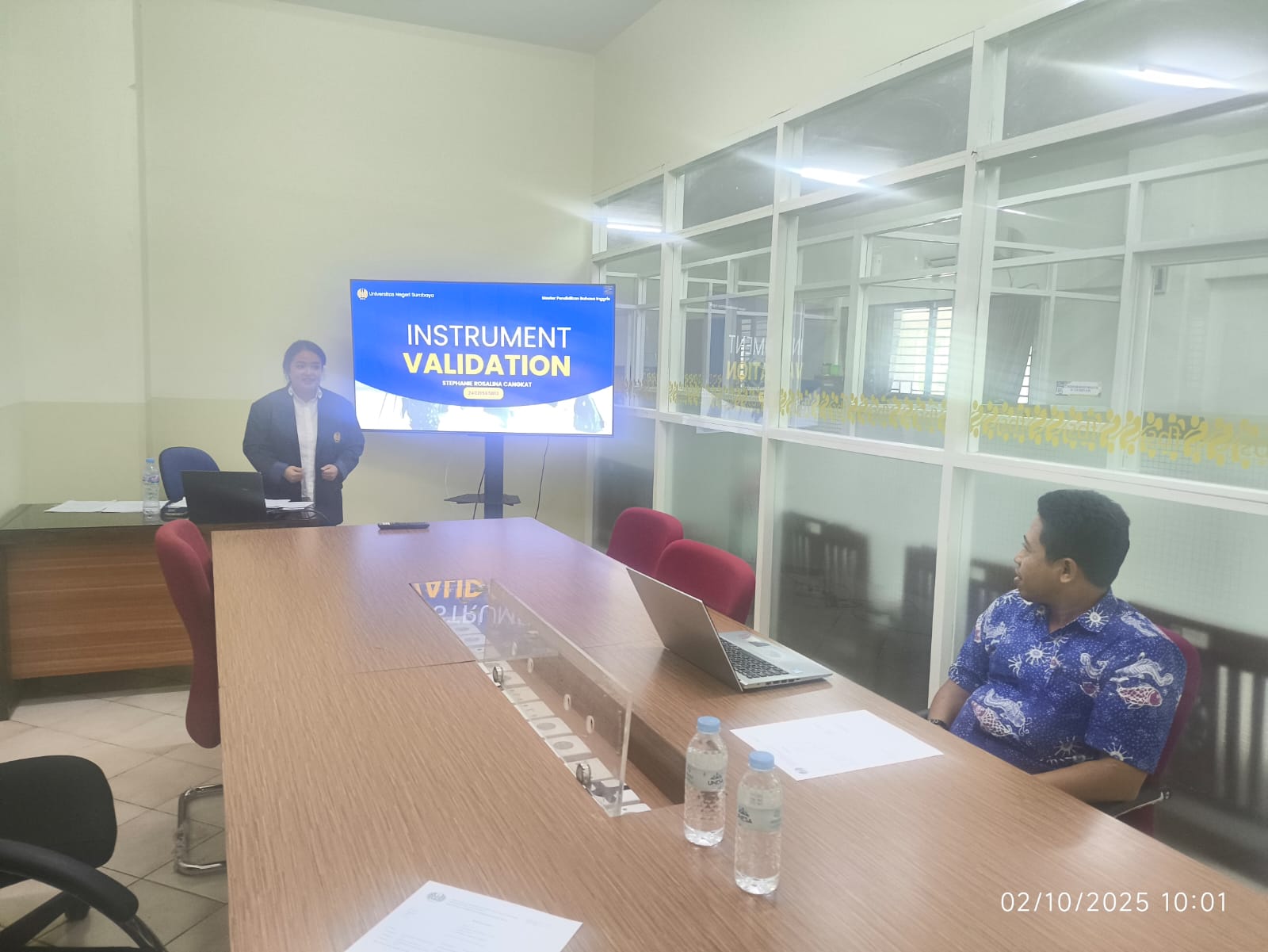
Stephanie’s research proposal highlights a significant gap in educational research, which is the absence of well-developed and well-established SRL instruments for young learners. Existing tools are predominantly designed for high school or university students, and thus are often cognitively and linguistically inappropriate for children.
During her presentation, Stephanie introduced a set of instrument items designed and developed using Zimmerman’s three-phase SRL model, forethought, performance, and self-reflection. She explained how the items were carefully adapted to match the cognitive level and emotional development of 6th grade students. She also emphasized the use of child-friendly visual design and language to ensure that students do not feel overwhelmed or stressed during the assessment.
A Promising Contribution to SRL Research on Children
One of the key takeaways from the seminar was the potential of Stephanie’s instrument to serve as a reference for future SRL research involving children. With appropriate validation and field testing, the instrument could become a valuable tool for both researchers and educators seeking to assess and foster self-regulated learning skills in younger learners—especially in light of the current education trends emphasizing independent learning.
Dr. Muhaimin Abdullah, S.Pd., provided insightful feedback on the content validity and language clarity, while Prof. Slamet Setiawan, M.A., Ph.D and Syafi'ul Anam, Ph.D., highlighted the importance of field trials and inter-aspect consistency. Ahmad Munir, Ph.D., as the program coordinator, expressed strong support for the initiative.
Supporting Quality Education (SDGs 4) through Early SRL Development
Stephanie’s research aligns closely with the goals outlined in the United Nations Sustainable Development Goals (SDGs), particularly Goal 4: Quality Education. By focusing on the development of a valid and reliable instrument to measure self-regulated learning (SRL) in elementary school students, this study supports efforts to promote inclusive, equitable, and effective learning opportunities for all. SRL is a key component of 21st-century learning skills, and cultivating it from an early age empowers students to take ownership of their learning processes, both in and beyond the classroom. Moreover, by addressing the lack of age-appropriate assessment tools, Stephanie’s work contributes to improving the quality of educational interventions and teacher practices. A well-validated SRL instrument for children can help educators identify students’ learning needs, tailor instruction accordingly, and foster lifelong learning habits—an essential aspect of ensuring sustainable and equitable education as promoted by the SDGs.
